Farm leaders and federal officials tour Canadian-controlled phosphate terminal under construction on the St. Lawrence Seaway
Canada NewsWire
EDWARDSBURGH CARDINAL, ON, Aug. 17, 2026
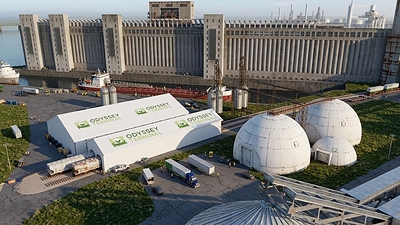
V6 Agronomy's Odyssey Terminal at the Port of Johnstown is designed to handle 400,000 tonnes a year, close to 20 per cent of Canada's phosphate demand, with Canadian grain exported on the return leg.
EDWARDSBURGH CARDINAL, ON, Aug. 17, 2026 /CNW/ -- Canadian farm organizations and federal officials toured the Port of Johnstown on August 13th to see the fertilizer terminal that V6 Agronomy is building on the St. Lawrence Seaway. The tour was hosted by Fertilizer Canada.
Phosphorus is essential to every crop grown in Canada, and the country produces no phosphate fertilizer. More than two million tonnes of commercial phosphate products are imported each year, with roughly 60 per cent moving from or through the United States before reaching a Canadian farm. Most of that supply depends on a single corridor.
When the Prime Minister launched the National Food Security Strategy in June, he said Canada's food chains rely too heavily on foreign suppliers and called for "more choice, more control, and more Canada." Phosphate is an input no farm can do without, and V6 Agronomy's Odyssey Terminal gives Canadian agriculture a route it controls.
Ocean vessels discharge phosphate and enhanced efficiency fertilizers directly onto the Seaway at Johnstown, and product moves inland by rail to discharge points across the Prairies. Fertilizer is one of the largest input costs on a farm, and the corridor is designed to lower the landed cost of phosphate for Canadian growers.
Because the corridor runs in both directions, railcars that would otherwise return empty will carry Canadian grain back east for export from the port's existing facilities. Removing the empty leg improves the economics and lowers the cost and emissions attached to every tonne moved.
The route is already proven. The first vessel discharged at the terminal in late 2025, demonstrating the berth, the discharge equipment and the rail connection under working conditions. Construction of the permanent facility began in July 2026, with the first building scheduled for completion by the end of the year. At full build the corridor is designed to handle 400,000 tonnes a year, close to 20 per cent of Canada's annual phosphate demand. The bulk of the inbound tonnage will transit to western Canada where 85% of Canada's annual phosphate imports are consumed annually. Remaining volumes will be stored to support the important ag retailers that supply crop inputs to more than 1,600 farms within the port's service area.
"Every spring, Canadian farmers depend on a fertilizer supply chain that runs through another country," said Ryan Brophy, Chief Executive Officer of V6 Agronomy. "That has been true for decades, and nobody built the alternative because the infrastructure economics never worked. They work now, and we are putting it in the ground."
The event brought together representatives from federal departments, national farm organizations and the transportation sector. Participants visited the marine facilities, the terminal site, the vessel unloading and grain handling areas and the rail connections, before touring the adjacent CREWS Rail facility.
"Canadian farmers depend on imports of phosphates to grow their crops," said Catherine King, Vice President, Corporate Affairs, Fertilizer Canada. "Canada's fertilizer industry and our farmer customers rely on Canada's trade infrastructure to ensure the products they need get to them when they need it most. It was great to see firsthand how smaller Canadian ports can play an essential role in strengthening Canada's supply chains and diversifying our trade."
"The Port of Johnstown has moved agricultural goods for decades, and this is the kind of investment that puts underused capacity to work," said Leslie Drynan, General Manager of the Port of Johnstown. "It brings volume, it brings jobs to this township, and it gives growers a Canadian route for a product they cannot farm without."
The Port of Johnstown is a municipally owned deepwater port on the St. Lawrence Seaway, operated by the Township of Edwardsburgh/Cardinal, with marine, rail and highway access. The port can berth six Seawaymax vessels at a time with cargoes up to 24,000 tonnes each.
About V6 Agronomy
V6 Agronomy Inc. is a Canadian agricultural inputs company based in eastern Ontario. The company handles fertilizer at the Port of Johnstown, operates a distribution hub at Wilcox, Saskatchewan, and develops patented fertilizer technologies.
About Fertilizer Canada
Fertilizer Canada represents producers, manufacturers, importers, wholesale and retail distributors of nitrogen, phosphate, potash and sulphur fertilizers. The fertilizer industry plays an essential role in Canada's economy, contributing over $42 billion annually and employing over 118,000 workers throughout the supply chain. We are committed to supporting the industry through innovation, stewardship, safety and security. As the foundation of Canada's agri-food sector, we apply innovative solutions that positively impact agriculture, the economy, and the social fabric of Canadian life.
Photographs and aerial footage available on request.

SOURCE V6 Agronomy Inc.

